---
description: Enabling content trust in Docker
keywords: content, trust, security, docker, documentation
title: Content trust in Docker
aliases:
- /engine/security/trust/content_trust/
- /notary/getting_started/
- /notary/advanced_usage/
- /notary/service_architecture/
- /notary/running_a_service/
- /notary/changelog/
- /notary/reference/server-config/
- /notary/reference/signer-config/
- /notary/reference/client-config/
- /notary/reference/common-configs/
---

When transferring data among networked systems, trust is a central concern. In
particular, when communicating over an untrusted medium such as the internet, it
is critical to ensure the integrity and the publisher of all the data a system
operates on. You use Docker Engine to push and pull images (data) to a
public or private registry. Content trust gives you the ability to verify both
the integrity and the publisher of all the data received from a registry over
any channel.

## About Docker Content Trust (DCT)

Docker Content Trust (DCT) provides the ability to use digital signatures for
data sent to and received from remote Docker registries. These signatures allow
client-side or runtime verification of the integrity and publisher of specific
image tags.

Through DCT, image publishers can sign their images and image consumers can
ensure that the images they pull are signed. Publishers could be individuals
or organizations manually signing their content or automated software supply
chains signing content as part of their release process.

### Image tags and DCT

An individual image record has the following identifier:

```text
[REGISTRY_HOST[:REGISTRY_PORT]/]REPOSITORY[:TAG]
```

A particular image `REPOSITORY` can have multiple tags. For example, `latest` and
 `3.1.2` are both tags on the `mongo` image. An image publisher can build an image
 and tag combination many times changing the image with each build.

DCT is associated with the `TAG` portion of an image. Each image repository has
a set of keys that image publishers use to sign an image tag. Image publishers
have discretion on which tags they sign.

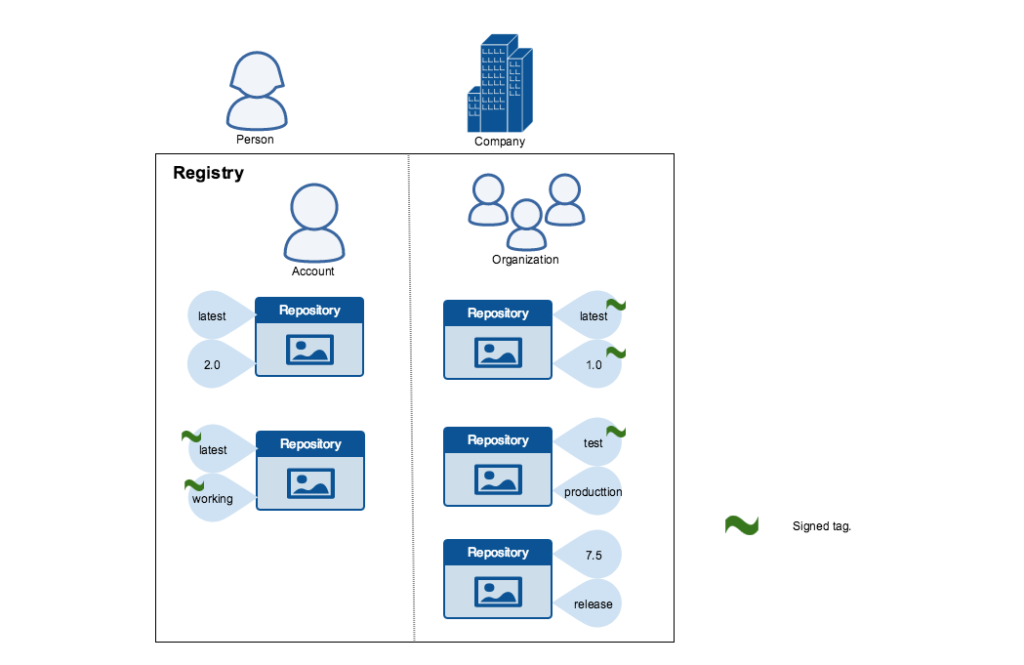
An image repository can contain an image with one tag that is signed and another
tag that is not. For example, consider [the Mongo image
repository](https://hub.docker.com/r/library/mongo/tags/). The `latest`
tag could be unsigned while the `3.1.6` tag could be signed. It is the
responsibility of the image publisher to decide if an image tag is signed or
not. In this representation, some image tags are signed, others are not: